Showing posts with label Brown Shrike. Show all posts

27 April, 2014

2014 | 117 | 27Apr14 | Hesaraghatta

01. Booted Warbler (Iduna caligata)
ID by  Richard Grimmett : Small, with square-ended tail, and short undertail-coverts. Often shows faint whitish edges and tip to tail and fringe to tertials. Supercilium usually reasonably distinct and square-ended behind the eye, and can be bordered above by a diffuse dark line. Typically shorter- and finer-billed than Sykes's, with more prominent supercilium, and upperparts are warmer brown; it usually appears more Phylloscopus-like, owingto shorter bill, and more frequently feeds on the ground. Possibly confusable with Common Chiffchaff, but lacks any greenish or olive tones, and has pale base to lower mandible and pale legs.
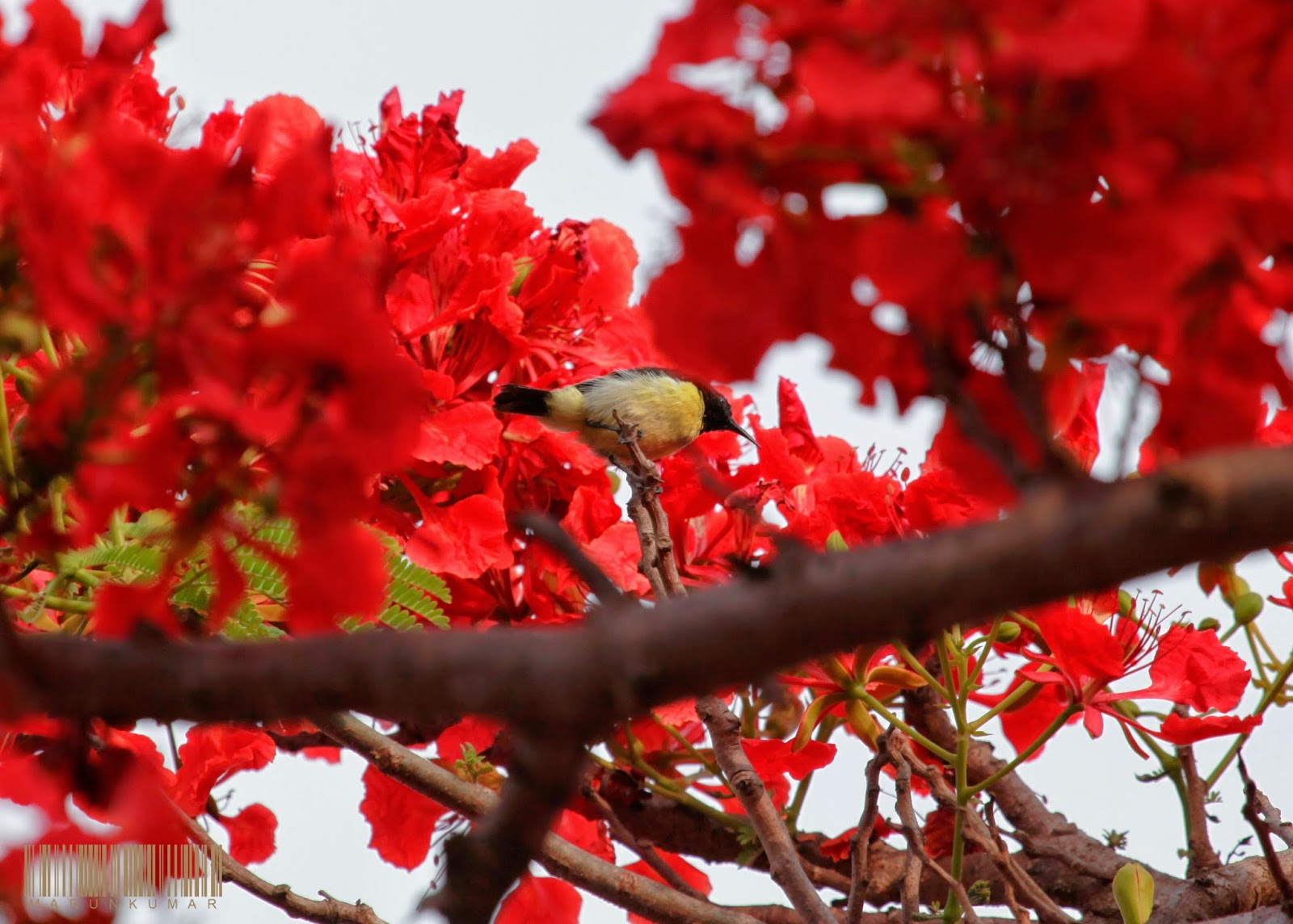
02. Purple Sunbird (Cinnyris asiaticus) - Male
ID by  Richard Grimmett : Has shorter and less down curved bill than Loten's. Male is metallic blue-green and purple becoming blacker on belly and vent. Female has uniform yellowish underparts, with faint supercilium and darker mask (whiter below in worn plumage). Eclipse male is as female, but has a broad blackish stripe down centre of throat and breast, metallic blue wing coverts and glossy black wings and tail. Juvenile is brighter yellow on entire underparts than female.
03. Brahminy Kite (Haliastur indus) - Adult
ID by  Richard Grimmett : Small size and kite-like flight. Wings usually angled at carpals. Tail rounded. Adult mainly chestnut, with white head, neck and breast. Juvenile mainly brown, with pale streaking on head, mantle and breast, large pale patch at base of primaries on underwing, and pale brown and unmarked underside to tail.
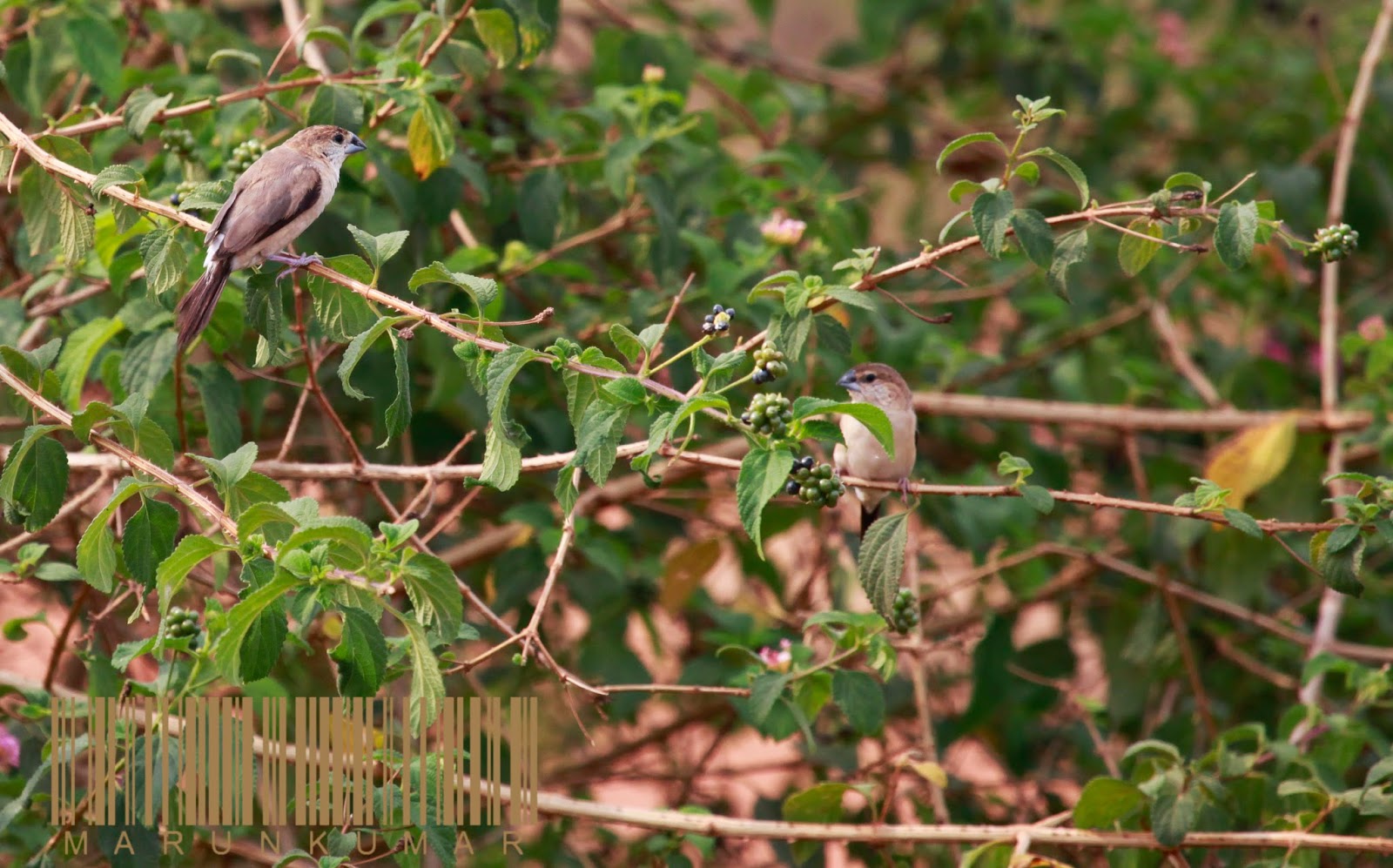
04. Indian Silverbill or White-throated Munia
(Lonchura malabarica)  - Male
ID by  Richard Grimmett : Male has fawn brown upperparts, whitish face and underparts with barred flanks, long and pointed black tail, and white rump and uppertail-coverts. Female is duller with plainer face, and flanks are less barred. Juvenile lacks barring on flanks, has dark mottling on rump, and tail is shorter and more rounded.
ID by  Wikipedia : The adult Indian Silverbill is 11–11.5 cm long and has a conical silver-grey bill, buff-brown upperparts, white underparts, buffy flanks and dark wings. The tail is black and the wings are dark contrasting with a white rump. The sexes are similar.
05. Purple-rumped Sunbird (Leptocoma zeylonica) - Male
ID by  Richard Grimmett : Male has narrow maroon breast-band, maroon head sides and mantle, metallic green shoulder patch, and yellow lower breast and belly with distinctive greyish-white flanks. Does not have eclipse plumage.
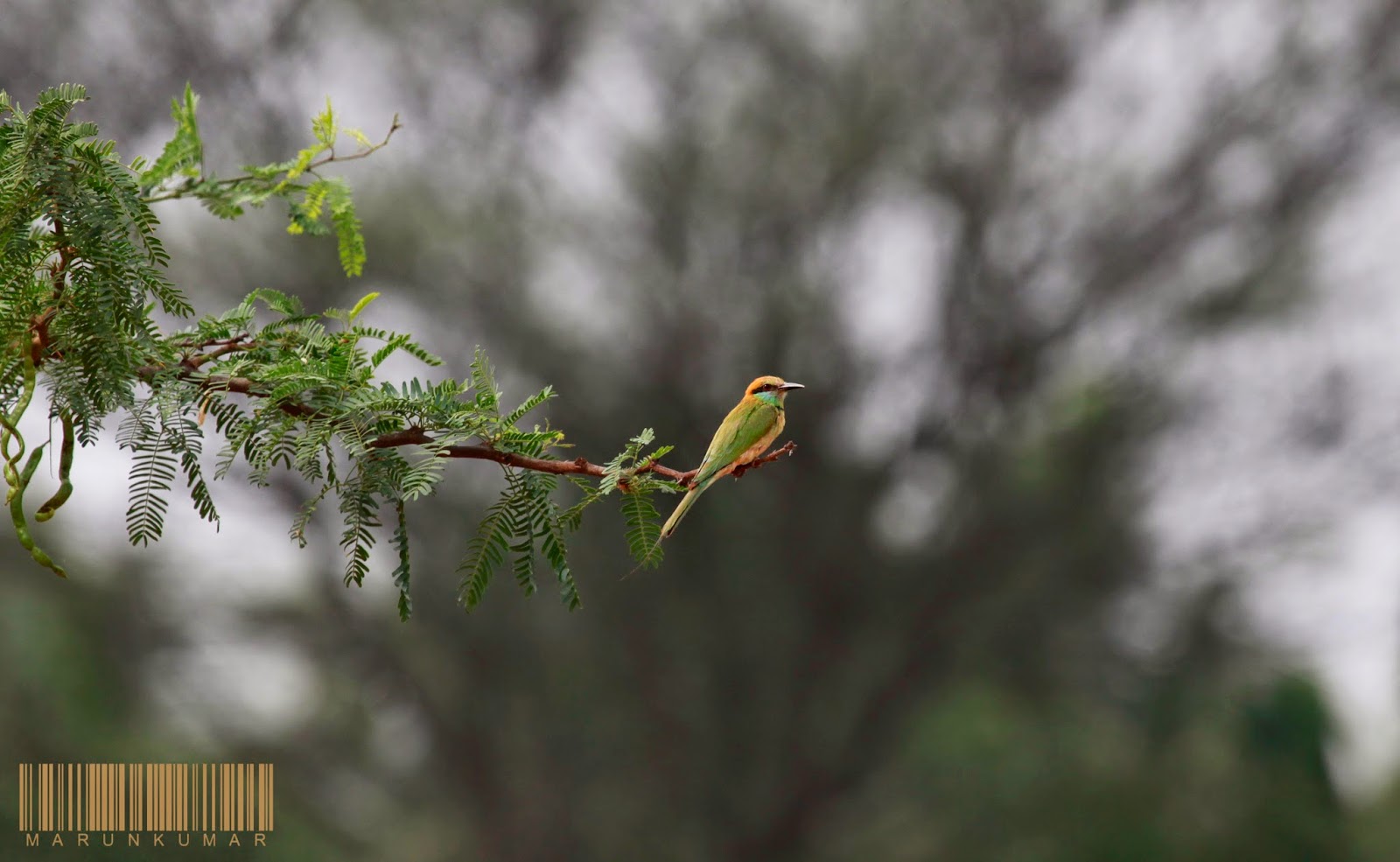
06. Green Bee-eater (Merops orientalis) - Adult
ID by  Richard Grimmett : Small with elongated central tail feathers, blue or green throat with black gorget, variable golden-brown to rufous crown and nape, and green tail
ID by  Wikipedia: Like other bee-eaters, this species is a richly coloured, slender bird. It is about 9 inches (16–18 cm) long with about 2 inches made up by the elongated central tail-feathers. The sexes are not visually distinguishable. The entire plumage is bright green and tinged with blue especially on the chin and throat. The crown and upper back are tinged with golden rufous. The flight feathers are rufous washed with green and tipped with blackish. A fine black line runs in front of and behind the eye. 
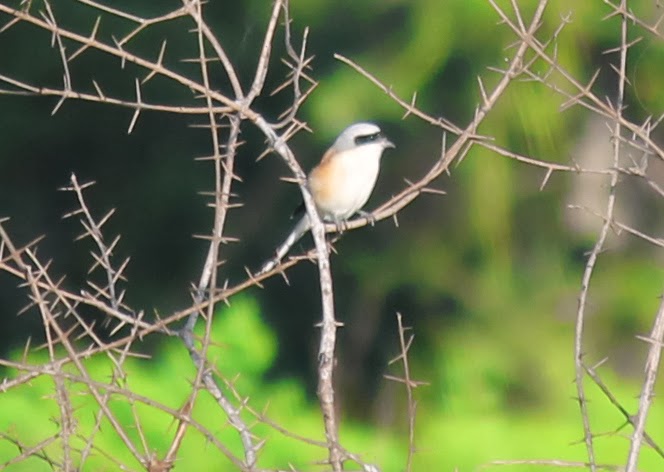
07. Brown Shrike (Lanius cristatus) - Female
ID by  Richard Grimmett : Typically has darker and more uniform rufous-brown upperparts, and warmer rufous flanks. Also thicker bill, more graduated tail and lacks white patch at base of primaries (apparent in male and some female Red-tailed). Female has paler lores and faint dark scaling on breast and flanks.

08. Crimson Rose (Pachliopta hector) - Male
ID by  Wikipedia: Male Upperside black. Fore wing with a broad white interrupted band from the subcostal nervure opposite the origin of veins 10 and 11, extended obliquely to the tornus, and a second short pre-apical similar band; both bands composed of detached irregularly indented broad streaks in the interspaces. Hind wing with a diseal posteriorly strongly curved series of seven crimson spots followed by a subterminal series of crimson lunules. Cilia black alternated with white. Underside: fore whig dull brownish black, hind wing black; markings as on the npporsido, but the crimson spots and crescentic markings on the hind wing larger. Antennae, thorax and abdomen abovo at base, black; head and rest of the abdomen bright crimson; beneath: iho palpi, the sides of the thorax and abdomen crimson.
Female. Similar, the discal series of spots and subterminal lunules much duller, pale crimson irrorated with black scales; in some specimens the anterior spots and lunules almost white barely tinged with crimson; abdomen above with the black colour extended further towards the apex.

16 November, 2013

2013 | 319 | 15Nov13 | Abbanakuppe Lake | Bidadi


View Larger Map
Latlong : 12.7755, 77.4055

1. Brown Shrike
Audio Credit : Ramit Singal, Manipal, India
http://www.xeno-canto.org/species/Lanius-cristatus?&view=3


Brown Shrike
ID 01 Distinctive black "bandit-mask" through the eye.
தனித்தன்மை வாய்ந்த முகமுடி அணிந்த கண்கள்
02 Brown on the upper parts and the tail is rounded.
மேல் பகுதிகள் பழுப்பு நிறத்திலும் வால் வட்ட வடிவில் காணப்படும்,
03 The black mask can be paler in winter and has a white brow over it.
04 Underside is creamy with rufous flanks and belly.
05 Wings are brown and lack any white "mirror" patches.
06 Females tend to have fine scalloping on the underside and the mask is dark brown and not as well marked as in the male.
07 The tail is more brownish
Habitat 08 Found in open scrub habitats,
Distribution 09 Found mainly in Asia.
10 The nominate form breeds in northern Asia from Mongolia to Siberia and winters in South Asia, Myanmar and the Malay Peninsula.
Behavior & Ecology 11 Migratory species and often return to same location each winter.
12 Arrive in winter to India in August to September and departure in April.
13 The breeding season is late May or June
14 Breeding habitat includes the taiga, forest to semi- desert where they build a nest in a tree or bush, laying 2-6 eggs.
Feeding 15 Feed on insects, especially insects including butterfly & moths.
16 They impale prey on thorns. Small birds and lizards are also sometimes preyed on.
17 They typically look out for prey from a perch and fly down towards the ground to capture them.
Source : Wikipedia
02. Scaly Breasted Munia


Audio Credit : Sander Bot, Holland
http://www.xeno-canto.org/species/Lonchura-punctulata

Scaly-Breasted Munia
ID 01 It's a sparrow-sized estrildid finch native to tropical Asia.
02Its name is based on the distinct scale-like feather markings on the breast and belly.
03The adult is brown above and has a dark conical bill.
04This Munia eats mainly on grass seeds apart from berries and small insects.
05They forage in flocks and communicate with soft calls and whistles.
06The species is highly social and may sometimes roost with other species of munias.
07This species is found in tropical plains and grasslands.
08The Scaly-breasted Munia is about 11–12 centimetres (4.3–4.7 in) long and weighs 12–16 grams.
09The adult has a stubby dark bill typical of grain eating birds, brown upperparts and a dark brown head.
10The underparts are white with dark scale markings.
11The sexes are similar, although males have darker markings on the underside and a darker throat than females.
12Immature birds have pale brown upperparts, lack the dark head found in adults, and have uniform buff underparts
13Breeding pairs construct dome-shaped nests using grass or bamboo leaves.
Social14Scaly-breasted Munias form flocks of as many as 100 birds.
15Individuals communicate with calls that include a short whistle, variations of kitty-kitty-kitty, and a sharp chipping alarm note.
Breeding16The breeding season is during the summer rainy season (mainly June to August in India) but can vary.
17The nest is a large domed structure loosely woven from blades of grass, bamboo or other leaves with a side entrance and is placed in a tree or under the eaves of a house.
Egg18Scaly-breasted Munia clutch usually contain 4 to 6 eggs, but can contain up to 10.
19Both sexes build the nest and incubate the eggs, which hatch in 10 to 16 days.
20Juveniles typically fledge in three weeks.
21Scaly-breasted Munias have a typical life expectancy of 6 to 8 years.
Food22The Scaly-breasted Munia feeds mainly on seeds but also eats small berries
23They may also feed on algae, a rich protein source, prior to the breeding season.
Source : Wikipedia

03 November, 2013

2013 | 307 | 03Nov13 | Vedanthangal

1. Yellow-Throated Sparrow

Yellow-Throated Sparrow
Description 01. It has a finer bill than typical sparrows and unlike them has no streaks on the plumage.

02. The white double wing bar on the shoulder is diagnostic on the otherwise dull grey-brown sparrow.

03. Males have a chestnut shoulder patch.

04. They also have a pale yellow spot on the throat in fresh plumage.

05. Females are duller and lack the chestnut shoulder patch.

06. The yellow spot is much reduced or lacking in females.

07. This species is tree-loving although sometimes seen on wires and hopping on the ground.

08. The usual call is a "chirrup" but the song is distinctive and repetitive "chilp chalp cholp".

09. It has a bounding flight and dips deeply before rising up.


Habitat 10. Found in Asia.

11. It is found in forest, gardens and open scrub habitats.

Behaviour 12. The species breeds in tree hollows from April to July, often making use of the holes made by primary hole-nesting birds such as barbets and woodpeckers.

13. They may also make use of hollows on buildings.

14. The nest is built mainly by the female.

15. The female alone incubates the eggs.

16. The eggs hatch after about 12 to 14 days.

17. They roost communally in low bushes.

18. Some populations are migratory, moving in response to rains.

19. They feed mainly on grains but also on insects, nectar and berries.


Distribution 20. The Chestnut-shouldered Petronia is found from Turkey into Iran, Afghanistan, Pakistan, India, Bangladesh and as a vagrant in Sri Lanka and possibly parts of Myanmar.

21. It is found in forest, gardens and open scrub habitats.


Source : Wikipedia

2. Caterpillar

3. Indian Roller


Indian Roller
01 Found widely across tropical Asia
02 Best known for the aerobatic displays of the male during the breeding season.
03 Seen perched along roadside trees and wires and in open grassland and scrub forest habitats.
04 It is not migratory, but undertakes some seasonal movements.
05 Is a stocky bird about 26–27 cm long.
06 The breast is brownish.
07 The crown and vent are blue.
08 The primaries are deep purplish blue with a band of pale blue.
09 The tail is sky blue with a terminal band of Prussian blue and the central feathers are dull green.
10 The neck and throat are purplish lilac with white shaft streaks.
11 The bare patch around the eye is ochre in colour.
12 Have a long and compressed bill with a curved upper edge and a hooked tip.
13 The nostril is long and exposed and there are long rictal bristles at the base of the bill.
14 They perch mainly on 3—10 metre high perches and feed mostly on ground insects.
15 Nearly 50% of their prey are beetles and 25% made up by grasshoppers and crickets.
16 During summer, they may also feed late in the evening and make use of artificial lights and feed on insects attracted to them.
17 Holes created by woodpeckers or wood boring insects in palms are favoured for nesting in some areas.
18 The normal clutch consists of about 3-5 eggs. The eggs are white and broad oval or nearly spherical.
19 Both sexes incubate the eggs for about 17 to 19 days.
20 The call of the Indian Roller is a harsh crow-like chack sound.
21 The Indian Roller has been chosen as the state bird by the Indian states of Andhra Pradesh, Bihar, Karnataka and Odisha.
Source : Wikipedia
4. Shikra


Shikra
From Wikipedia, the free encyclopedia
01 Found widely distributed in Asia and Africa.
02 Is a small raptor 26–30 cm long
03 Has short rounded wings and a narrow and somewhat long tail.
04 Adults are whitish on the underside with fine rufous bars while the upperparts are grey.
05 The lower belly is less barred and the thighs are whitish.
06 Males have a red iris while the females have a less red (yellowish orange) iris and brownish upperparts apart from heavier barring on the underparts.
07 The females are slightly larger.
08 The mesial stripe on the throat is dark but narrow.
09 The central tail feathers are unbanded and only have a dark terminal band.
10 Juveniles have dark streaks and spots on the upper breast and the wing is narrowly barred while the tail has dark but narrow bands.
11 A post juvenile transitional plumage is found with very strong barring on the contour feathers of the underside.
12 The call is pee-wee.
13 In flight the calls are shorter and sharper kik-ki ... kik-ki.
14 The Shikra is found in a range of habitats including forests, farmland and urban areas.
15 They are usually seen singly or in pairs.
16 The flight is typical with flaps and glides.
17 During the breeding season pairs will soar on thermals and stoop at each other.
18 They feed on rodents, squirrels, small birds, small reptiles and insects.
19 They will descend to the ground to feast on emerging winged termites
20 Hunt at dusk for small bats
21 The breeding season in India is in summer from March to June.
22 The nest is a platform similar to that of crows lined with grass.
23 Both sexes help build the nest, twigs being carried in their feet.
24 The usual clutch is 3 to 4 eggs
25 Eggs are pale bluish grey stippled on the broad end in black.
26 The incubation period is 18 to 21 days.

5. Bay Backed Shrike


Bay-backed Shrike
From Wikipedia, the free encyclopedia
01 Resident in South Asia.
02 It is smallish shrike at 17 cm,
03 Maroon-brown above with a pale rump and long black tail with white edges.
04 The underparts are white, but with buff flanks.
05 The crown and nape are grey, with a typical shrike black bandit mask through the eye.
06 There is a small white wing patch, and the bill and legs are dark grey.
07 Sexes are similar, but young birds are washed-out versions of the adults.
08 Percheing on a bush, it sallies after lizards, large insects, small birds and rodents.
09 Prey may be impaled upon a sharp point, such as a thorn.
10 Thus secured they can be ripped with the strong hooked bill, but its feet are not suited for tearing.
00 It is a widespread resident breeder in Afghanistan, Pakistan and India, Sri Lanka.
00 It nests in bushes in scrubby areas and cultivation, laying 3-5 eggs.

6. Jacobin Cuckoo
7. Jacobin Cuckoo
8. Ashy Wood Swallow

Ashy Woodswallow - சாம்பல் தகைவிலான்
From Wikipedia, the free encyclopedia
01 Sometimes called the Ashy Swallow-shrike is a woodswallow which is found in south Asia.
02 Has a short curve bill and a short square tail and long wings.
03 Usually seen perched in groups, high on powerlines, tall bare trees and most often in areas with a predominance of tall palm trees.
04 In flight, the broad base to the wings gives it a very triangular outline
05 This stocky woodswallow has an ashy grey upperparts with a darker head and a narrow pale band on the rump.
06 The underside is pinkish grey and the short slaty black tail is tipped in white.
07 The finch-like bill is silvery.
08 The first primary is very short.
09 There are no geographic variations in plumage and no subspecies have been designated.
10 Males and females are indistinguishable in the field.
11 Young birds appear barred on the underside.
12 Habitat and distribution
13 Woodswallows are found in a range of habitats from the plains to about 2000 m, over cultivated areas, in forest clearings and often in areas with tall palm trees.
14 The species is widely distributed across India, Nepal, Sri Lanka, Thailand, Burma, Laos, Malaysia and China.
15 Length 190 mm (7.5 in), Weight 37–42 g (1.3–1.5 oz)
16 Ashy Woodswallows are usually seen in small groups.
17 Several birds may sit huddled side-by-side.
18 Insects may be caught in the beak, transferred and held in their feet, torn up with their bill and swallowed without returning to the perch.
19 Known to visit bird baths.
20 Although mainly feeding on insects, they may take nectar from flowers
21 The breeding season is March to June.
22 The nest is a shallow cup placed at some height.
23 The clutch consists of 2–3 greenish white eggs with brown spots.
24 Both parents take part in nest building, incubation and feeding the young.
25 They will mob larger birds such as crows and birds of prey
26 The song consists of a varied combination of wheezy notes that may include imitations of the calls of other birds.
27 The usual call is shrill nasal chewk.
28 They make seasonal movements, possibly in response to rainfall.

15 October, 2013

2013 | 287 | 14Oct13 | Jamunamarathur Forest

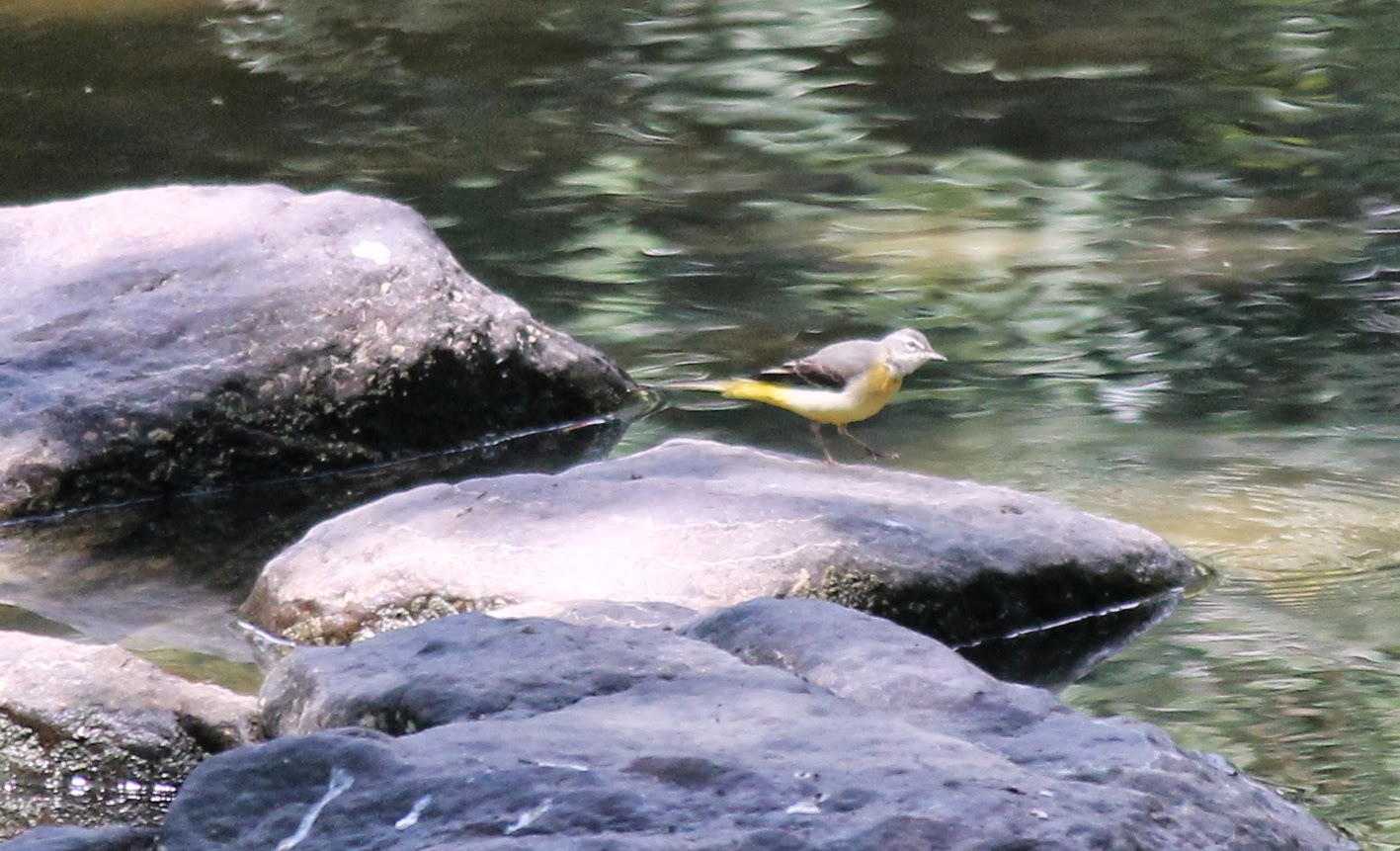
1. Grey Wagtail

2. Giant Wood Spider

3.Grasshopper
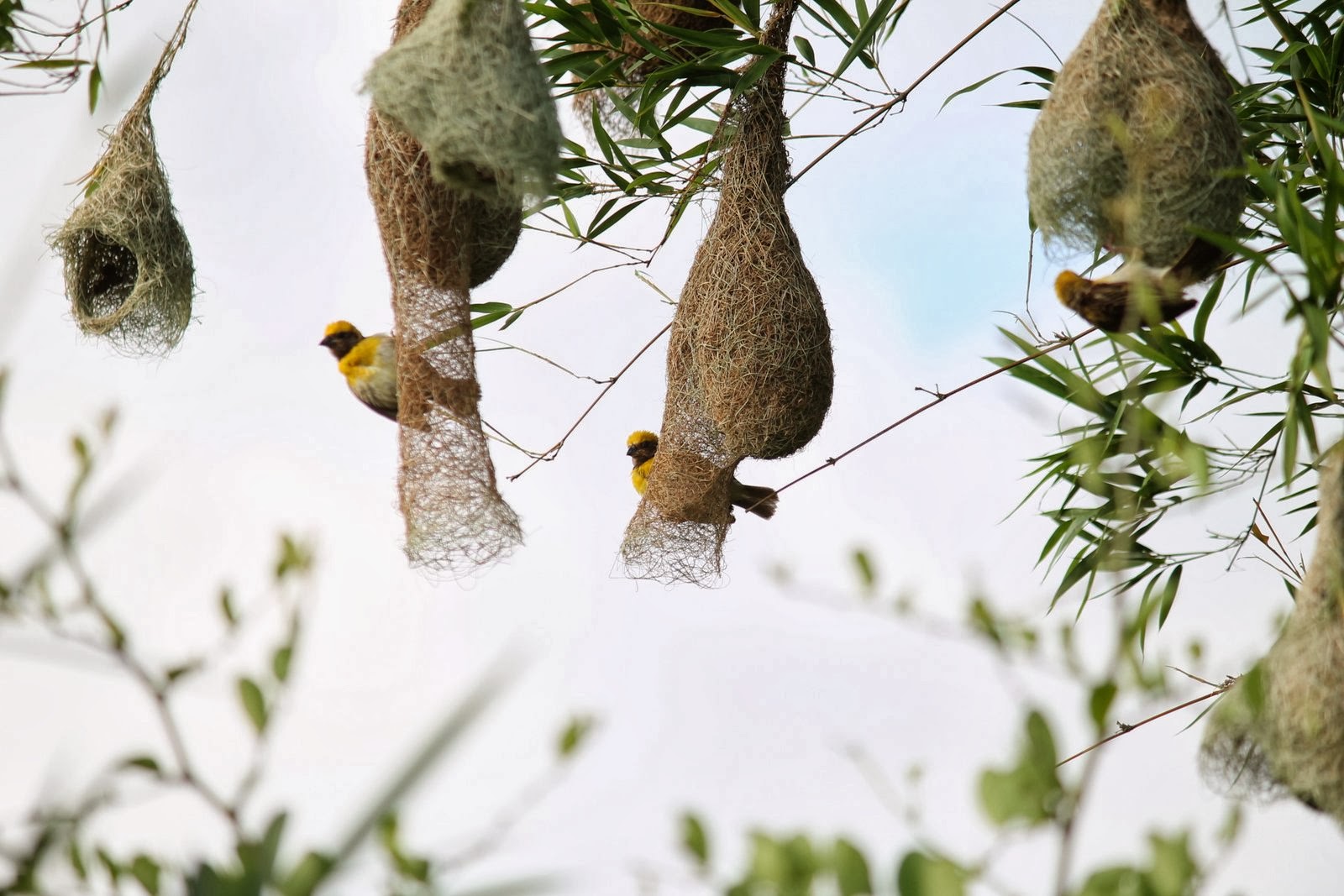
4. Baya Weaver
Baya Weaver
Baya Weaver
Baya Weaver
5. Common Kingfisher
6. Brown Shrike

7. Coppersmith Barbet
                         
8. Spotted Owlet